As I am writing my dissertation on crow-human relations during the time of the Vernal Equinox, I hear many crows outside rejoicing. They consume the coral blossoms that bloom this time of year, and enjoy the nutrients provided for their spring courting, and nesting. Already, I have been hearing early crow babies crying out from their high nests. It reminds me of what crow expert Kevin McGowan, at Cornell, suggests; that the venery name, or plural of crows, might be changed from a murder, to a bouquet—a bouquet of crows! Considering their lively nature, I agree!
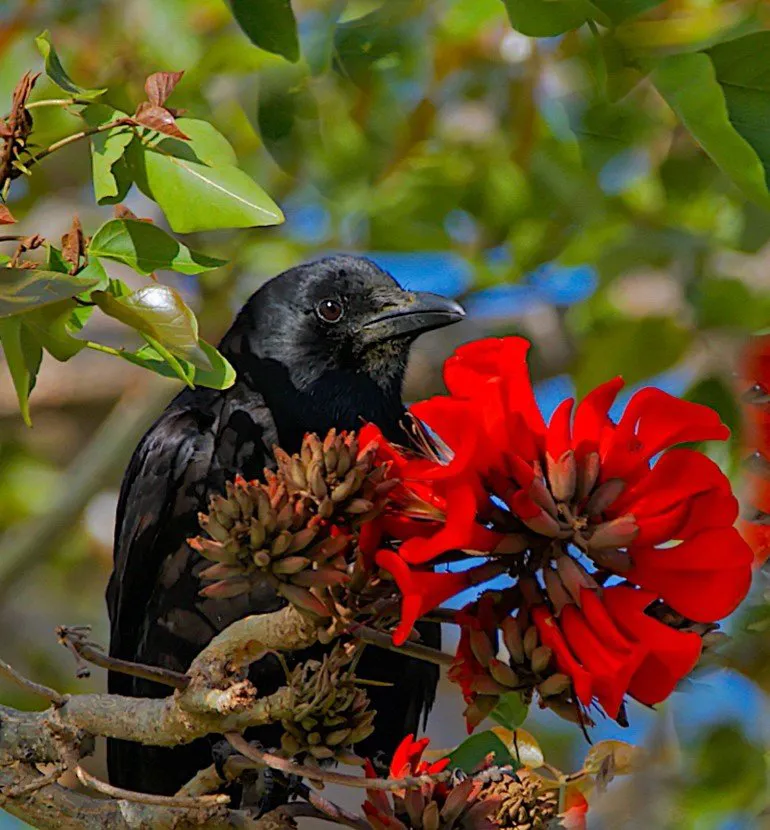
Spring is a busy time for so many songbirds. Crows, in case you didn’t know, are considered songbirds. They may not sound particularly melodious to some folks, but to me, the crow’s caw is music to the ears. This is because of what I know about them—they our co-evolutionary kin, creative and complex, and their dialects so many, that scientists find it daunting to interpret. One thing that is known, is that crows are cognitively and culturally complex, cooperative breeders (meaning their nests consist of many family members, even grown relations, as helpers), and have long been our corvid cousins on this planet.
It is no wonder that they are in the Indigenous origin stories of many cultures, and particularly, many stories that have to do with the sun, and fire. The Lenape of the Delaware River Valley, once called the Lenapehoking lands, tell the story of the Rainbow Crow, the most famous, perhaps, of crow stories. To condense and summarize, the story went that the world was a warm, paradise for all animals, and then Great Spirit thought about cold and snow, and so there was a great winter over the land. All animals would have perished but for the sacrifice of the rainbow crow, who volunteered to bring fire down, and melt the snow. In doing so, crow burned all their feathers black. As a reward, Great Spirit left rainbows in the crow feathers, and crow was content to be iridescent. Great Spirit also gave crow the gift to never be ruled by the coming race of humans, to never be captured for their song or feathers, and to never be hunted as food (because of their taste). For the actual story…refer to The Rainbow Crow by Nancy Van Lean, and this wonderful link, here.
In ancient Eastern stories the Sun Crow promises rebirth of springtime, as what is called the “Spring Crow” or Chunsheng. The crow is often associated with the sun, fire, and spring in many world cultures. The Anishinaabe (Ojibwe) refer to the Spring or Vernal Equinoctial moon as the Aandego-giizis, or “Crow Moon.”
For me and many of us, I am sure, this is a time of renewal after a long, challenging, time of darkness. I cannot help but feel gratitude when I see the rejoicing of the crows, symbolic of the sun, and resilience, and regeneration. May we all flourish together in regeneration, and honor the “bouquets of crows” blooming in spring.