Especially in Autumn, I enjoy walking while the moon is still out, and the city is still when many trees are turning red and scattering their burnished leaves everywhere. Autumn is my favorite season for several reasons: Halloween (formerly known as Samhain), the light is most excellent for photography, and the crows begin to gather in greater numbers called roosts. From September to November, American crows (Corvus brachyrhyncos) gather in greater and greater numbers, foraging by day, and roosting by night. Since they are not nesting, they roost with their mates, children, and extended family groups.
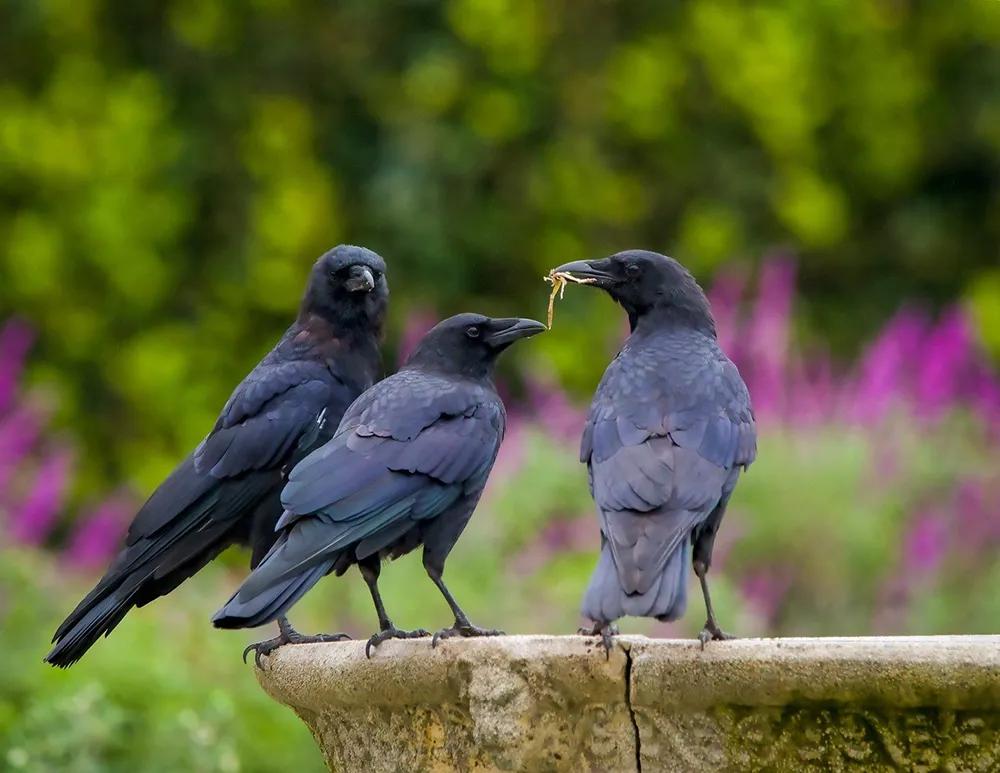
The other morning, I noticed the sound of crows cawing anxiously in the distance. I could tell there was something wrong, as a line of crows spread across the sky, heading toward the park. I could tell that they were probably heading to gather for a funeral. In case you didn’t know, crows hold large gatherings much like funerals, where they surround the dead and cry out…usually if there is a mate or family, the mate and family members will be closest to the body, and sometimes act in various ways indicating their distress.
When I got to the park, sure enough, hundreds of crows were gathered in the baseball field, where one crow lay dead. I watched as they circled around, then backed away. After the main funereal behavior, they all headed nearby and gathered together, for what seems a lot like a “wake” period, in which they are no longer focused on the body itself, but rather seem to be communicating. There has been research (Swift, 2015) documenting many of these occasions. Primarily the researcher’s assessment is that crows gather to glean information about possible dangers.
As I walked near to observe, I kept a respectful distance, as I would to a human funeral to which I wasn’t invited. I reflected to myself that to me, this was a moving event, watching them express their various emotions and reactions to the demise of one of their own. Research concludes that their brains are much like primate brains, that they possess close familial ties…some researchers I have spoken to say there is no reason not to think that they may feel grief, as well as assessing and communicating about what might have caused the death—don’t humans often ask the cause of other humans’ deaths to measure whether they may need to be cautious?
I also reflected on how I am attuned to crow lives, but most humans do not notice this crow funeral. Many humans either dislike, adore, or ignore crows. Whatever the case, the crow-human relationship is deeply entangled and complex. The western narrative around crows has been negative since the culling of crows began with intensive agriculture…before that, crows and their raven cousins were revered and protected by laws. More recently, crows have become a subject of interest, as researchers have learned much about their complex cognition, similar to primate cognition, that they may be convergently evolved with primates, and that they certainly are culturally coevolved with humans (Marzluff, 2012).
This season brings much beauty in things that many humans enjoy…but for me, I find much beauty in the crow communities and their culture. They are devoted family members and mate for life, often showing much affection and loyalty. One of my favorite things is watching their various behaviors during this time of year, especially as they gather to roost.
I am soon sitting down to write my dissertation about that very complex crow-human relationship…and there is no better time to begin than the season of the crow.